
Advanced Toruses
Flow, Continuity & the Five Elements in Dynamic Equilibrium
Introduction
The torus is a foundational geometric form found throughout nature, mathematics, and systems theory. It represents continuous flow—an unbroken loop where energy moves inward, circulates, and returns outward in a balanced cycle.
In this advanced study, the torus is explored not only as a geometric structure, but as a model of dynamic equilibrium, expressing how systems maintain stability through constant movement.
Continuous Flow
Understand the torus as a living system of continuous circulation where energy constantly moves, transforms, and returns to equilibrium.
Dynamic Equilibrium
Explore how stability is maintained through movement, balance, and ongoing energetic exchange rather than stillness.
Natural Intelligence
Discover how toroidal structures appear throughout nature, biology, mathematics, and energetic systems.
The Geometry of the Torus
A torus is created when a circle rotates around an external axis, forming a continuous ring-shaped surface. This structure embodies:
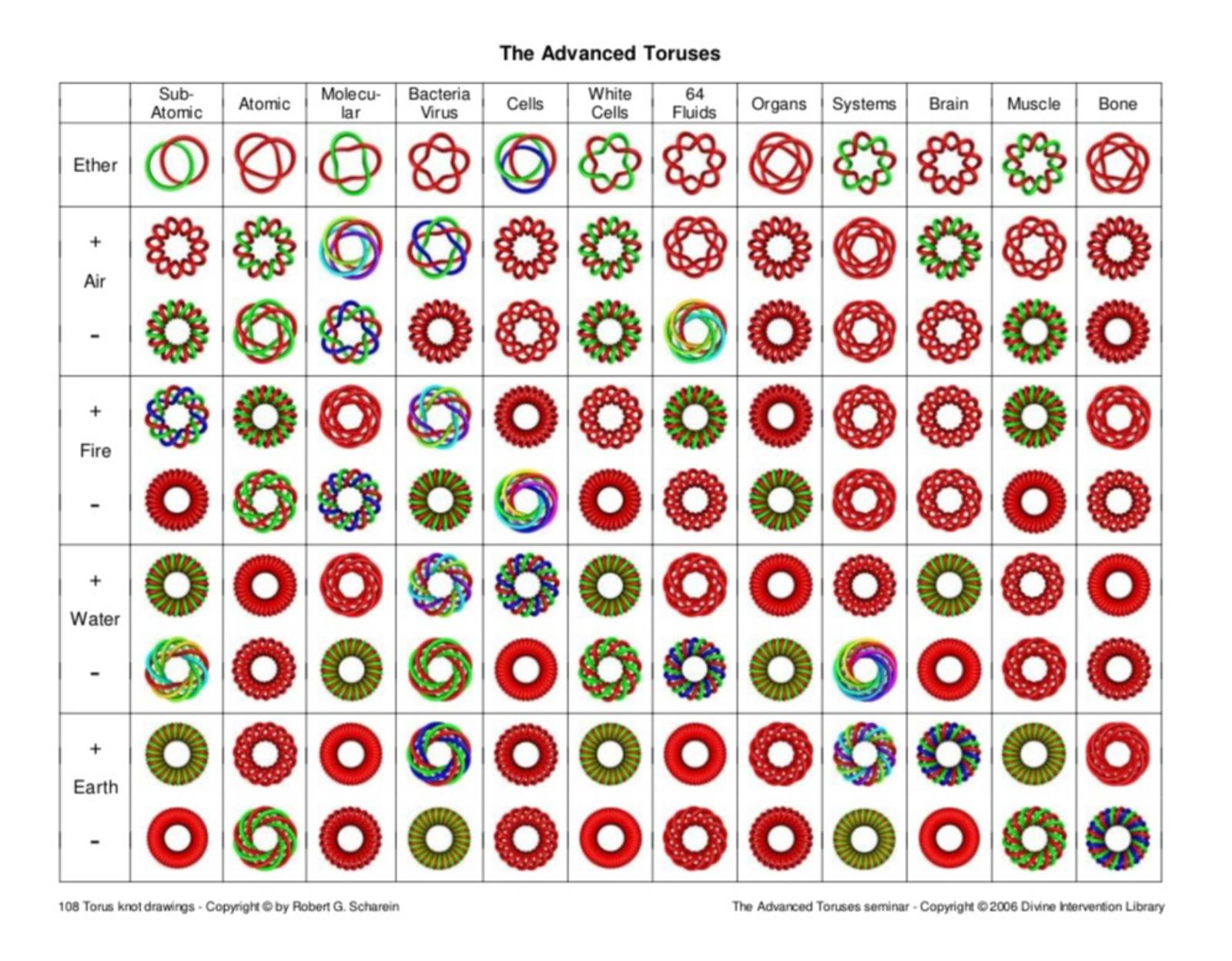
- Continuous circulation without beginning or end.
- Inner and outer flow simultaneously coexisting.
- Self-sustaining movement through recursive motion.
The torus represents continuous energetic movement, where input and output are part of a single system. Nothing is static; everything is in motion.
Key Principles
Inward & Outward Flow
Understand the relationship between absorption, circulation, and outward expression within one continuous energetic system.
Cyclical Regeneration
Observe how energy renews itself through continuous circulation and recursive movement.
Expansion & Contraction
Discover how stability arises through the balance between opposing yet complementary forces.
The Five Elements in Dynamic Equilibrium
Within this advanced framework, the torus is used as a model to explore the Five Elements as interacting forces within a unified system.
Earth
Structure, stability and form.
Water
Flow, adaptation and emotion.
Fire
Transformation, expansion and activation.
Air
Movement, communication and change.
Aether (Space)
Integration, awareness and the unified field.
Each element is not separate, but continuously moving through the toroidal field in a state of dynamic balance. The torus becomes the structure through which these elemental qualities circulate, transform, and return to equilibrium.
Integration
The toroidal form reflects how systems in nature—biological, energetic, and environmental—maintain balance through circulation rather than stillness.
Advanced Torus study offers a way to perceive reality as a continuous field of movement and relationship. Rather than viewing systems as static structures, the torus reveals them as living processes of exchange and transformation.
Through this lens, geometry becomes a language of flow, and flow becomes the foundation of form.